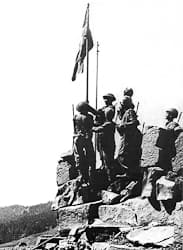
Markets are rarely won by the organisation with the biggest resources. More often, they are won by those that recognise change early, prepare better than their competitors, and act decisively when the opportunity appears. Operation Meghdoot offers a compelling example of this principle.
The success of the operation did not begin in April 1984 when Indian troops occupied the Saltoro Ridge. It began several years earlier through a series of military mountaineering expeditions that gradually revealed Pakistan's attempts to establish a presence in the Siachen region. Rather than dismissing these as isolated events, Indian planners recognised a long-term strategic pattern. This early understanding shaped every decision that followed.
Recognising Weak Signals
For business leaders, the lesson is straightforward. Competitive advantage often starts with recognising weak signals before they become obvious to the market. Customer behaviour, emerging technologies, new partnerships, or small shifts in regulation may appear insignificant in isolation. Organisations that study these developments systematically are better positioned to shape the future rather than react to it.
Capability Before Expansion
Equally important was the emphasis on preparation. Before occupying the glacier, specialised troops underwent rigorous training in ice craft, snow survival, physical endurance, and mountain operations. These investments in capability ensured that execution, when ordered, was swift and effective.
Businesses frequently reverse this sequence by expanding into new markets before developing the necessary capabilities. Operation Meghdoot demonstrates that capability development should precede large-scale expansion. Pilot projects, specialised training, and organisational learning reduce uncertainty and improve execution when decisive action becomes necessary.
The Integrated Approach
Another striking feature of the operation was its integrated approach. Intelligence gathered by frontline expeditions informed military planning. Army Headquarters, field commanders, political leadership, and the Indian Air Force worked in close coordination before the operation was launched. Logistics became as important as combat itself, ensuring that newly established positions could be sustained in one of the harshest environments on earth.
The corporate equivalent is clear. Strategy cannot succeed in isolation. Sales, operations, finance, technology, and supply chains must work towards the same objective. Organisations often lose momentum not because the strategy is flawed but because different functions execute independently rather than collectively.
The Value of Being First
Perhaps the greatest lesson lies in the value of being the first mover. By occupying the dominating heights before Pakistan could do so, India fundamentally changed the competitive environment. Thereafter, every Pakistani attempt to alter the situation required significantly greater effort, cost, and risk. The initiative had shifted permanently.
Businesses achieve similar advantages when they establish early positions through innovation, customer trust, proprietary capabilities, or distribution networks. A first mover does not simply enter the market earlier; it forces competitors to operate within conditions it has already shaped.
Operation Meghdoot ultimately shows that enduring advantage is built through foresight, disciplined preparation, coordinated execution, and sustained investment. Organisations that consistently develop these capabilities are better equipped not only to respond to competition but also to define the environment in which competition takes place.